
INEC Postpones Nationwide Voter Revalidation Exercise Ahead of 2027 Elections

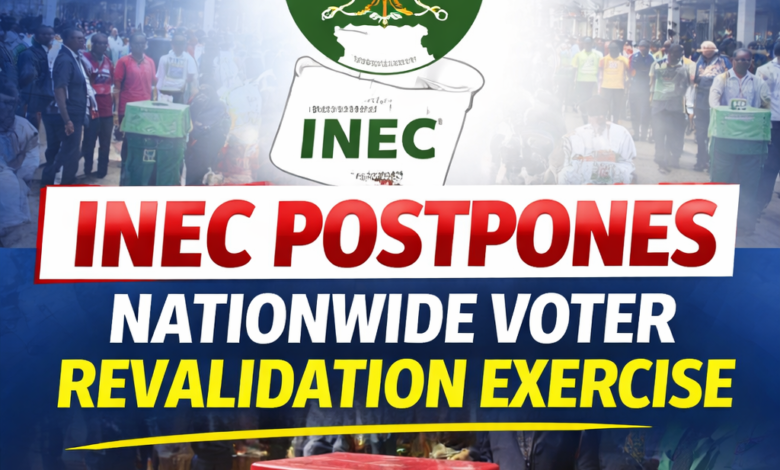
The Independent National Electoral Commission (INEC) has once again made a headline-grabbing announcement that is sending shockwaves across Nigeria’s political landscape. INEC postpones nationwide voter revalidation exercise a decision that has sparked widespread debate among politicians, civil society organisations, and millions of registered voters who were preparing to update or revalidate their voter registration details. If you are a Nigerian citizen wondering what this postponement means for your voting rights, your Permanent Voter Card (PVC), and the future of Nigeria’s electoral process, this article breaks it all down for you in plain, honest language.
Why INEC Postpones Nationwide Voter Revalidation Exercise: The Official Reasons
When news broke that INEC had postponed the nationwide voter revalidation exercise, the first question on every Nigerian’s lips was simple: Why? The Commission offered a number of official explanations to justify the sudden postponement, and understanding these reasons is critical to appreciating the full picture.



According to INEC’s official communications, logistical and operational challenges were among the primary factors cited. The commission stated that adequate preparation was still underway, including the deployment of Bimodal Voter Accreditation System (BVAS) machines and the training of ad hoc registration staff across Nigeria’s 36 states and the Federal Capital Territory (FCT). The sheer scale of a nationwide exercise covering over 176,000 polling units demands extraordinary coordination, and INEC maintains that it would rather delay than conduct a flawed exercise.
Funding constraints also played a visible role. INEC’s dependence on government budget releases means that without timely disbursement of funds from the Federal Government, key components such as procurement of materials, deployment logistics, and public sensitisation campaigns cannot move forward as planned. Civil society groups have long argued that INEC must be granted full financial autonomy to avoid such recurring disruptions.
Additionally, there have been concerns raised about cybersecurity readiness. Following global conversations about election integrity and digital manipulation, INEC has been under pressure to ensure that its voter database is protected from breaches before any mass revalidation exercise is conducted. Rushing the process could expose millions of voter records to risk.
For official updates directly from the commission, you can visit the INEC Official Website for the latest press releases and statements.
Understanding the Nationwide Voter Revalidation Exercise: What It Is and Why It Matters
Before reacting to the postponement, it is important to understand what the nationwide voter revalidation exercise actually involves and why it was considered necessary in the first place.
A voter revalidation exercise is a formal process through which INEC verifies and updates the details of already-registered voters in Nigeria. It differs from Continuous Voter Registration (CVR), which targets new registrants. Revalidation is designed for existing voters who may have changed their residential address, whose biometric data needs updating, whose names contain errors, or whose PVCs were never collected.

Nigeria’s voter register currently contains millions of records many of which are outdated, duplicated, or contain errors accumulated over decades of registration exercises. The integrity of Nigeria’s elections is directly tied to the accuracy of this register. When the voter roll is bloated with ghost voters, duplicate entries, or unverifiable data, it creates room for electoral manipulation and undermines public confidence in democracy.
The importance of a credible voter register cannot be overstated. According to Yiaga Africa, a leading civic technology and election observation organisation in Nigeria, data integrity at the voter registration level is foundational to credible elections. When INEC postpones the nationwide voter revalidation exercise, it delays this critical cleaning and verification process and time is always a factor in electoral planning.
The Political Context: Reactions From Across Nigeria’s Political Spectrum
The announcement that INEC postpones nationwide voter revalidation exercise did not happen in a political vacuum. Nigeria is perpetually in some phase of electoral preparation, and the timing of any INEC decision attracts intense political scrutiny.
Opposition political parties were quick to voice their frustration. Several party spokespersons accused INEC of institutional inefficiency, pointing to a pattern of postponements that, in their view, reflects deeper structural problems within the Commission. Critics argue that INEC’s consistent inability to meet its own self-set deadlines erodes public trust in the electoral body.
On the other side, supporters of the ruling administration framed the postponement as a responsible and mature decision arguing that a poorly executed voter exercise is far worse than a delayed but well-planned one. They point to the 2023 general elections as evidence that INEC is capable of conducting elections that are largely credible, noting that the introduction of the BVAS machine was a significant step forward in reducing electoral fraud.
Civil society organisations, however, struck a more balanced tone. Groups like the Transition Monitoring Group (TMG) and the Centre for Democracy and Development called on INEC to provide a clear, transparent, and binding new timeline for the voter revalidation exercise. They warned against leaving voters in the dark without a concrete schedule, emphasising that public trust is an irreplaceable asset in democratic governance.
How the Postponement Affects Nigerian Voters on the Ground
For the average Nigerian voter, the postponement of the nationwide voter revalidation exercise is not merely a political talking point it has real, practical consequences.
Voters with collection issues: Millions of Nigerians who have never collected their Permanent Voter Cards are directly affected. Without the revalidation exercise, the opportunity to resolve collection-related problems remains postponed.
Newly mobile voters: Nigerians who have relocated from one state or local government area to another since their last registration cannot transfer their voter registration to their new address until a formal exercise is conducted. This effectively disenfranchises internally mobile Nigerians.
Voters with data errors: Many Nigerians discovered errors in their names, dates of birth, or photographs on their PVCs during the 2023 elections. The revalidation exercise was supposed to offer a pathway to correct these errors. The postponement leaves them in limbo.
Deceased voter clean-up: Perhaps most critically from a data integrity standpoint, the voter register continues to carry the records of deceased Nigerians who passed away after their initial registration. Without a periodic revalidation exercise, the dead stay on the rolls — creating openings for electoral manipulation.
For guidance on your voter registration status, the INEC Voter Enrolment Portal provides a self-service lookup feature where voters can verify their current registration details online.
INEC’s Track Record: A Pattern of Postponements and What It Reveals
This is not the first time INEC postpones a nationwide voter revalidation exercise or any large-scale electoral activity. A brief look at history reveals a troubling pattern.
In the lead-up to the 2019 general elections, INEC was criticised for last-minute logistics failures that led to widespread complaints about unavailable PVCs and BVAS-related accreditation issues. Before the 2023 elections, the upload of results on the INEC Result Viewing (IReV) portal faced documented delays and technical glitches that became the subject of major litigation before the Supreme Court.
Each postponement, whether of voter registration, revalidation, or election-day activities, contributes to a cumulative erosion of institutional credibility. The International Foundation for Electoral Systems (IFES), in its various reports on Nigerian elections, has consistently highlighted operational planning and resource mobilisation as areas where INEC needs sustained improvement. You can explore their comprehensive electoral research at IFES Nigeria.
The pattern also raises structural questions. Is INEC given enough independence and resources to do its work effectively? Electoral reform advocates have pushed for legislation that would give INEC a dedicated funding line that cannot be interfered with by executive branch delays. Without financial and operational autonomy, postponements will remain a recurring feature of Nigeria’s electoral calendar.
What Electoral Experts Say About Voter Revalidation and Democratic Health
Electoral experts across Africa are broadly agreed that periodic voter revalidation is not a luxury but a democratic necessity. Clean, accurate, and up-to-date voter registers are the foundation upon which the entire edifice of electoral credibility rests.
Dr. Aisha Abdullahi, a governance scholar at the University of Abuja, has noted in various public lectures that Nigeria’s voter register has never undergone a truly comprehensive audit since mass registration began in the early 1990s. The cumulative effect of this neglect is a bloated register with systemic data quality problems that no amount of election-day technology can fully compensate for.
The African Union’s Democracy and Electoral Assistance Unit has published guidelines that recommend member states conduct voter register audits at least once every electoral cycle. Nigeria’s failure to consistently honour this recommendation is seen as a contributing factor to post-election disputes and litigation that have characterised recent electoral cycles.
The Electoral Institute for Sustainable Democracy in Africa (EISA) provides a wealth of comparative research on best practices in voter registration management across the continent, and Nigeria’s case is frequently cited as both a cautionary tale and an example of what technology-driven reforms can achieve when properly implemented.
The Road Ahead: What Must Happen After the Postponement
Now that INEC postpones nationwide voter revalidation exercise, the critical question is not just why it happened, but what comes next. Here is what stakeholders are calling for in the aftermath of this announcement.
A new, binding timeline: INEC must announce a clear, specific, and non-negotiable new date for the voter revalidation exercise. Vague assurances of “soon” are no longer acceptable to a citizenry that has heard such promises before.
Adequate and timely funding: The Federal Government must release all budgeted funds to INEC immediately, without conditions or delays. Electoral administration is not a discretionary expenditure — it is a constitutional obligation.
Public sensitisation campaigns: INEC must ramp up its public communication efforts through radio, television, social media, and community outreach. Millions of Nigerians in rural areas remain uninformed about voter registration processes, and this information gap must be closed before any exercise is conducted.
Engagement with civil society: INEC should deepen its collaboration with voter education and election observation organisations. Groups like Yiaga Africa, TMG, and the Nigeria Civil Society Situation Room have the grassroots reach that INEC needs to make any nationwide exercise successful.
Legislative support: The National Assembly must pass the long-overdue Electoral Act amendments that would protect INEC’s funding, independence, and operational timelines from political interference.
Final Thoughts: Democracy Is Not a Spectator Sport
The fact that INEC postpones nationwide voter revalidation exercise is frustrating, disappointing, and — if patterns hold — unsurprising. But outrage, while valid, is not enough. Every Nigerian who cares about the quality of their democracy must stay engaged, stay informed, and hold both INEC and elected officials accountable.
Democracy does not run on autopilot. It requires vigilant citizens, adequately resourced institutions, and political leaders who genuinely believe in the rules of the game. The voter revalidation exercise, when it eventually holds, represents an opportunity to clean Nigeria’s electoral roll, empower disenfranchised voters, and lay a more credible foundation for the 2027 general elections.
Stay updated by bookmarking the INEC Official Website, following credible Nigerian news outlets such as Channels Television, Premium Times Nigeria, and The Punch, and engaging with election observer groups who hold the Commission to its mandate.
Your vote is your voice. Make sure it is registered, validated, and heard.
Related Reading:
- INEC Continuous Voter Registration: How to Register Online
- Understanding Your Permanent Voter Card (PVC) in Nigeria
- Nigeria’s Electoral Reform Journey: A Timeline
- How to Check Your Voter Registration Status Online
Tags: INEC, Voter Revalidation, Nigerian Elections, INEC Postponement, Voter Registration Nigeria, PVC Collection, 2027 Elections, Nigerian Democracy, Electoral Reform Nigeria, BVAS Nigeria
Disclaimer: This article is for informational and public interest purposes. Always verify the latest information directly from INEC’s official channels, as electoral schedules are subject to change.


No,5b/434/Atenda Ibadan Total Garde Ibadan North oyo
The new riven tides arc raiders missions are easily the most challenging content we have faced so far on the surface. The machine aggression is dialed up to eleven, and extraction is never a guarantee. To survive the storm and extract with your loot, you should definitely upgrade your loadout using the riven tides arc raiders gear guide here. It makes a massive difference in high-stakes firefights.